Like having a child or planting a garden, annotating a book is an expression of hope for the future. Adding a comment to a text, I affirm that I, or someone, will pick up the volume again someday — that books will endure as objects of interest in a civilization not wholly digital. Rereading David Guterson’s The Other, I am pleased to discover that my younger self recognized in Chapter One’s lost-in-the-woods sequence a “broader existential crisis.” If my son or daughter pulls that novel off the shelf one day (kids, it’s a masterpiece), they’ll see my note, and we’ll have a kind of chat, even if I’m long dead.
Author: Jason
“I’m Not An Epidemiologist But…”: The Rise Of The Coronavirus Influencers
What happens when Twitter engagement decides who’s in charge of the coronavirus public health crisis? According to Tomas Pueyo, his Medium post titled “Coronavirus: Why You Must Act Now” has been viewed over 37 million times as of this week.
Coronavirus: The Hammer and the Dance
On March 10, Tomas Pueyo published a widely read and praised article called Coronavirus: Why You Must Act Now. Yesterday, in the wake of the Imperial College paper and the criticism of it, Pueyo has published a second article: Coronavirus: The Hammer and the Dance.
“Total annihilation”: Coronavirus may just be the end for many alt-weeklies
It was only seven days ago that we told you about The Stranger, the Seattle alt-(bi)weekly that was facing a financial crisis because of the city’s response to the coronavirus outbreak, which shut down concerts, bars, restaurants, and so many other events that provide the advertising fuel for an a
It’s Thursday?
It’s Thursday.
It’s Thursday, right?
Let Kids Be Kids
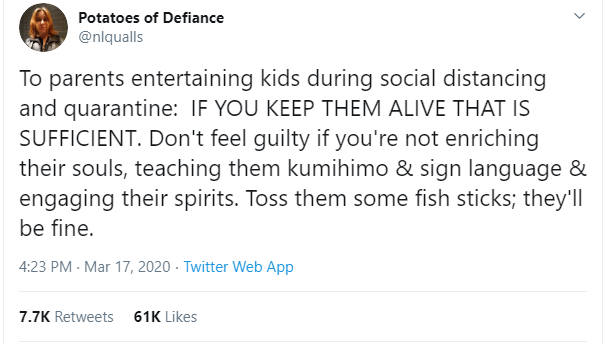
Amen.
It’s especially good to just let the kids decompress a bit too. I know my five year old is asking a lot of questions and was even having his action figures “fight coronavirus” earlier today. Dude’s processing everything too, having some time to just be a kid is OK.
‘Write It Down’: Historian Suggests Keeping a Record of Life During Pandemic
If you are going to compose a journal of these times, make it something easy to do. If a journal becomes onerous, it does not work. You do not have to write or do things for the journal every day. Keep your writing and composing close by, so you can jot things down to return to them later. Jot things down, a few words here and there, but then compose them in full sentences.
When you read an article that you find telling, produce a link in your journal and write a few brief reflections. Include photographs, from the press and those that you take.
Many of us are writing today and producing our work on social media. It is an explosion. You can gather these voices, these experiences, all this creativity. They are all a record of our times. These voices are urgent.
How will we deal, socially, psychologically, with the increasing number of deaths all around us? Many are saying that around the globe our lives will not be the same again.
The Dos and Don’ts of ‘Social Distancing’
If you’re confused about what to do right now, you’re not alone—even these experts occasionally disagreed on the answers to my questions. Where there were discrepancies, I’ve included all the different answers as fully as possible, and as the situation has evolved, I’ve allowed the experts to update their answers to questions to reflect new information. This guide is aimed toward those who are symptom-free and not part of an at-risk group, with an addendum at the end for those in quarantine. If you are symptom-free but are over 60 years old; have asthma, heart disease, or diabetes; or are otherwise at risk, experts recommend defaulting to the most conservative response to each of these questions.
There is a general consensus that while young and healthy people who are at lower risk for personally suffering severe illness from the coronavirus don’t have to be locking themselves in their homes for the next month, they do need to dramatically alter their daily lives, starting now.
My Corona
If you’ve felt the COVID-19 outbreak was missing a soundtrack, someone’s got you covered on Spotify.
Coronavirus and eLearning
As people champion the idea of more schools and universities exploring online classes in the face of coronavirus, it’s a good time to remember that not everyone has at home access to the equipment and technology necessary to participate.
Computers, internet, webcams, this stuff isn’t magically available for everyone. Yes, MOST people have these things at home, but those that don’t are more often than not those who need access to education the most.
And if we get to this point, it’s not like libraries are going to be a viable option.
Problem is, should we get to the point of schools closing, then what’s the solution? Aside from saying “school’s out!”?
Related: Many Districts Won’t Be Ready For Remote Learning If Coronavirus Closes Schools
Many students across the country are equipped with tablets and computers provided by their schools. More than half of 300 school IT leaders who responded to a 2019 Consortium of School Networking (CoSN) survey said their districts have at least begun moving towards 1:1 programs in which each student has a device to complete assignments during the school day and at home.
But that leaves out many school districts where such devices aren’t provided, as well as many students, particularly in rural areas and from low-income backgrounds, for whom home access to the internet or a personal digital device is out of reach.
Some school leaders haven’t yet figured out how they would maintain the flow of learning if school needs to close for an extended period of time. Sal Pascarella, the superintendent of Danbury Public Schools in Connecticut, is resigned to accept that students won’t be able to access new concepts or learning materials if they’re stuck at home for more than a few days.
“Our school district would not be able to sustain in a meaningful way substantive teaching in the content area on a platform like teleteaching,” Pascarella said.
Of the district’s 12,000 students, 52 percent are eligible for free and reduced-price lunch, and school resources are tight, Pascarella said. Some of the district’s high schools have begun developing e-learning capabilities more generally, he said, but elementary and middle schools are further behind. Developing bilingual programs for the district’s substantial population of English-language learners has also been a challenge, he said.